
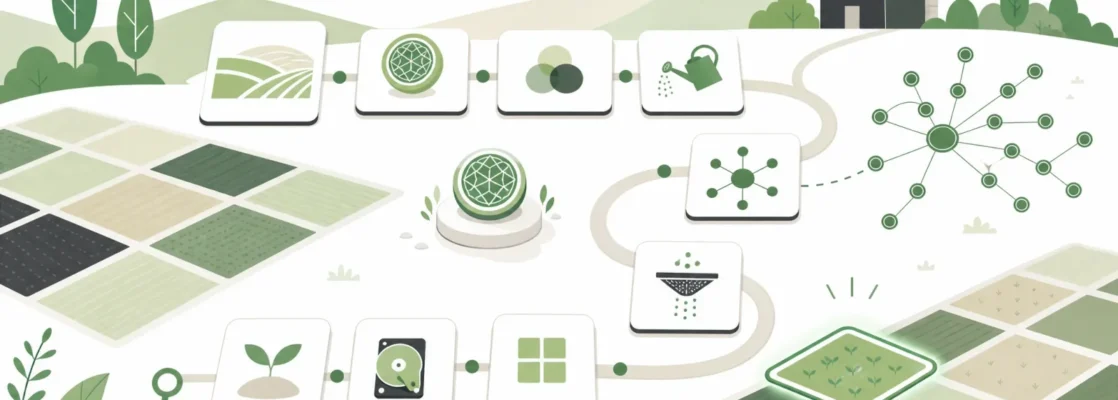
For readers approaching Chia plotting and farming for the first time, the most useful starting point may be a clear account of what a lesson series says it will cover. Chia Documentation’s Plotting & Farming page presents foundational lessons on those two subjects, then points readers toward related topics and a first-plot tutorial. Read this as a guide to the stated learning agenda, not as a claim about a particular setup, result, or strategy.
Start with the lesson scope
The page identifies plotting and farming as the basic terrain of this lesson group. That simple description gives a reader permission to begin with orientation rather than assume prior mastery. The stated coverage then broadens to challenges, including their distribution and processing. It also names pooling and plot filters as topics whose benefits to the network are addressed. Finally, the page says that a tutorial for making a first plot appears at the end. For a newcomer, that stated agenda is a useful frame for choosing what to read first. The order is less important than the boundary it sets: these are the subjects explicitly named by the material.
Keep the documentation tracks distinct
A separate Blockchain Basics overview places consensus, timelords, block formation, the coin-set model, and security within its own lesson coverage. That list establishes a wider conceptual context without turning the Plotting & Farming page into a substitute for it. In the supplied documentation extracts, plotting and farming stand as a distinct topic beside blockchain basics. This distinction is valuable because it lets readers separate a page’s declared subject from ideas covered on another overview. The result is a cleaner reading habit: follow the topic named on the page before attaching additional expectations to it.
Why the narrow reading matters
New readers can use the lesson scope as a checklist for questions they want answered while studying. Challenge distribution and processing belong on that list because the page expressly includes them. Pooling and plot filters belong there as well, since the page says it considers their network benefits. The first-plot tutorial provides a visible endpoint for the lesson sequence, rather than leaving the scope at abstract labels alone. Equally important, the page’s stated scope does not require readers to treat every neighboring blockchain subject as part of the same lesson. That is a modest but practical way to avoid reading more into a brief overview than it actually states.
Read the page for what it names
Documentation summaries are most helpful when readers preserve the difference between a named topic and an assumed explanation. Here, the named topics are plotting, farming, challenge distribution and processing, pooling, plot filters, and a first-plot tutorial. The separate basics overview names consensus, timelords, block formation, the coin-set model, and security. Keeping those lists intact supports a more precise view of the available learning paths. It also keeps the focus on the documentation’s own organization instead of importing claims about operation, outcomes, or requirements. That discipline makes the overview useful as an entry point while leaving technical detail to material that actually supplies it.
Conclusion
The Plotting & Farming lessons set out a compact agenda: basics, challenge handling, pooling, plot filters, and a first plot. The Blockchain Basics overview provides a separate agenda for broader concepts, including consensus and security. Taken together, the extracts encourage a straightforward approach: identify the lesson track, note its stated subjects, and resist extending its claims beyond them. For a reader seeking orientation, that is enough to make the documentation’s structure easier to navigate.